Sourdough Bread
What is sourdough?
Sourdough is a type of bread that is made with a fermentation process instead of your typical yeast loaf. During the fermentation process it creates a wild yeast that you mix in with your flour and water. Once that is all mixed and over the course of several hours you have a sourdough loaf. It’s crusty outside and sour flavor is what gives it its name.

How to make a sourdough starter?
To make a sourdough starter you combine flour and water which creates the starter. Then over the course of several days you discard a portion of that starter and you continue to feed it with flour and water. There are different ratios to make a sourdough starter happy where you live.
If you live somewhere that is low altitude an high humidity or vice versa then adjustments of you starter, flour, and water amount need to be made.
If you want to learn how to make your own starter, click here for a step by step guide on how to make your own sourdough starter.
Why does sourdough taste sour?
Sourdough is a natural fermentation process. When combining the water and flour it creates a wild yeast and lactic acid bacteria. That is what gives the sourdough its traditional “sour” flavor. It is what also helps the bread create a nice crust around the edges and what makes it gut healthy.
Where does sourdough originate?
Sourdough is one of the oldest forms of leavened bread, with origins tracing back over 5,000 years to ancient Egypt. It is believed Egyptians accidentally discovered sourdough when a mixture of flour and water was left out and naturally fermented by wild yeast and bacteria in the air. This happy accident created a bubbly, tangy dough that rose better than flatbreads.
Sourdough then spread throughout Europe—adopted by Greeks, Romans, and later bakers across France, Germany, and beyond. Each region developed its own unique starter culture based on local microbes. That is why climate and location play an important role in sourdough. You can buy a sourdough starter from someone online that advertises “100yr old dough”, but over time the dough will adapt to its climate an region it lives it.
So while sourdough isn’t tied to just one place anymore—it’s made worldwide—it all began with ancient bakers who let nature do the work. Pretty cool for something made from just flour, water, and time!
Do I have to use ice when baking my sourdough?
No, you do not have to use ice if you don’t want to. However, sourdough requires humidity. In a standard oven it doesn’t produce the best environment for a nice crusty crust. With the added steam it creates a perfect environment for the protective crust. Once you remove your lid it also helps brown the outer crust more.
Fermentation in the sourdough
Sourdough is fermented water and flour combined to create a wild yeast. The difference between wild yeast vs commercial yeast is that commercial yeast is made for consistent results and is engineered to be….stable. Wild yeast ferments slower and can change with different environments. This could result in one day your sourdough bread does amazing and the next time it doesn’t turn out as well.
What to do with my sourdough discard?
There are lots of things you can do with your sourdough discard, but first off…What is “discard”? Discard is the inactive portion of your sourdough starter. You know the stuff that is mixed in with your flour and water….that is the discard. Once it is fed and it becomes bubbly and active it is now active starter. After 12 hours the sourdough becomes inactive again and it would be considered discard.
If you follow my recipe for feeding your sourdough starter ratios, you will notice that once you make your loaf of bread with the ratios below, there is extra starter leftover. You have to keep a portion of that to discard to feed to maintain your starter. There are lots of ways you can store your starter.
Some people just throw away the discard, but there are lots of recipes you can make!
Sourdough Loaf
Equipment
- 1 dutch oven
- 1 kitchen scale
- 1 sourdough banneton
- 1 scoring knife
Ingredients
- 130 grams Active sourdough starter
- 400 grams filtered water 375g initially and 25g to mix salt
- 500 grams all-purpose unbleached flour
- 10 g salt
Instructions
- In a large mixing bowl whisk together active starter and 375g water until milky.

- Add your flour and use your hands to mix together thoroughly.
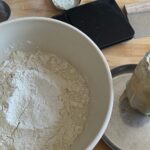
- Cover with a tea towel and let sit for 30 minutes.

- After it has sat, add 10g salt and the rest of the 25g filtered water and combine using your hands.

- Over the next 2 hours, every 30 minutes perform “stretch and folds”. Grab the corner of your bread dough, pull up and stretch to the opposite side. Do that for every corner. Cover the dough with a towel between stretch and folds. Your dough will become less sticky and have a more “dough-like” shape the more stretch and folds you perform.
- Once the stretch and folds are done you can place the covered bowl in the fridge for approximately 8hrs or until doubled in size. This is the fermentation process. You can also leave on the counter top until doubled in size.
- One doubled in size dump the dough out on the table. Stretch to make a rectangle and fold the sourdough “hotdog” style until there is one long rectangular piece. Roll that piece into a loaf and push and pull the bread to build tension.
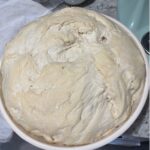
- Let rest for 20-30mins uncovered on the counter top. After resting perform that step again.
- Next you take your flour-ed sourdough bannetons and place the dough in right side down.

- Cover with a plastic wrap, I use plastic shower caps, and place in fridge for 3-4hours up to 3 days.
- Pre-heat oven to 450℉
- Place sourdough loaf on parchment paper and score the loaf.
- Place an ice cub in your cast iron pan, place sourdough loaf with the parchment paper in the cast iron pan, put lid on and place in oven.

- You will bake for 30 minutes with lid on. After 30 minutes remove lid and bake for an additional 15 minutes.
- Remove and let cool before cutting into.

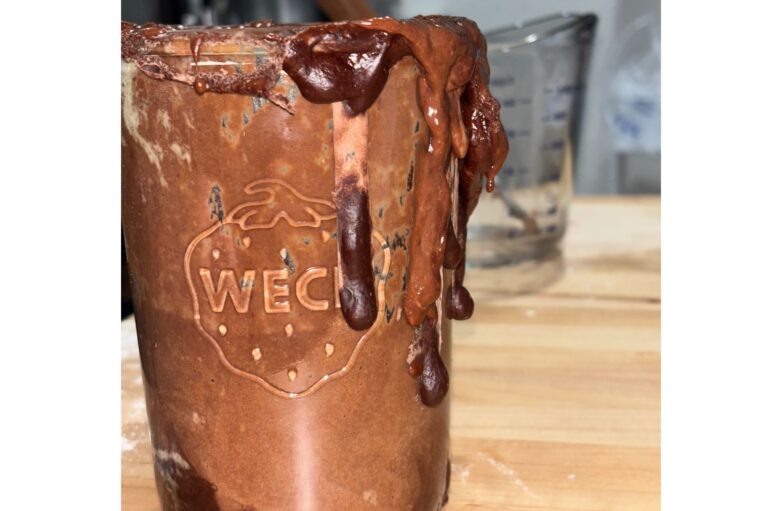


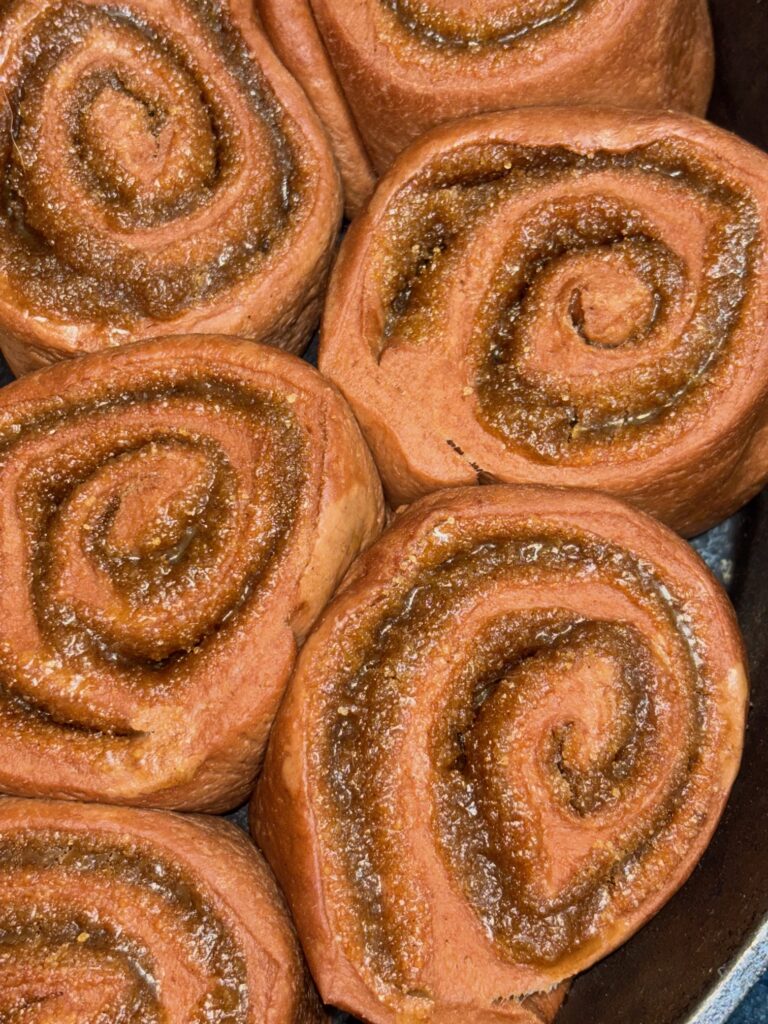


The best bread. It’s literally gone within 20min of Danielle bringing it to work